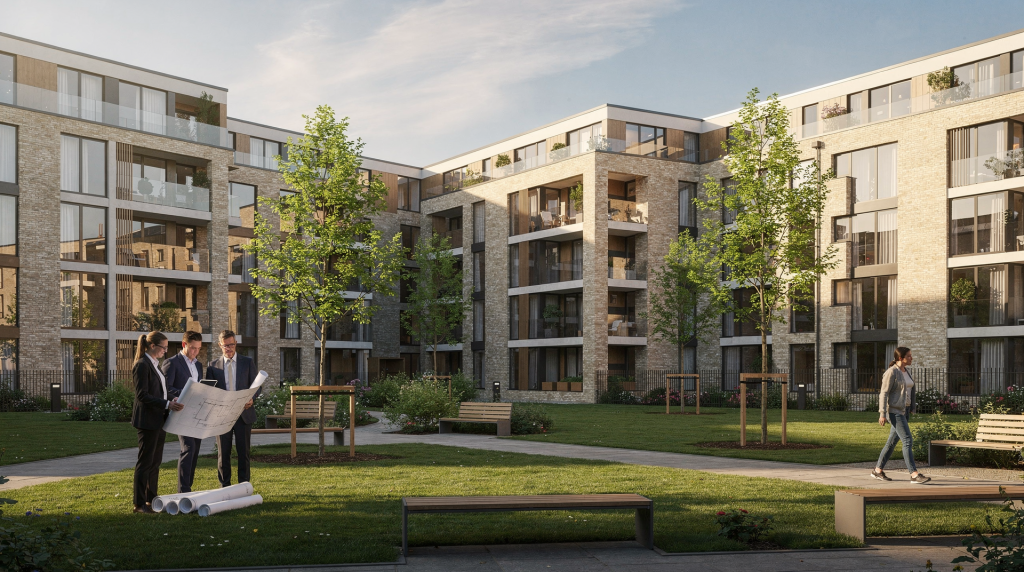
A residential launch is the moment when brand strategy, digital execution, and sales readiness either align to build instant credibility—or collide to create confusion that takes months to undo. After fifteen years of shaping brand identities for consumer goods across EMEA, I’ve seen the same pattern in property: the most successful launches are never about a single big campaign. They’re about a carefully constructed narrative that answers the unspoken questions buyers carry with them long before they fill in a form. When positioning, visual storytelling, channel mix, and sales operations work as one system, early interest converts into qualified enquiries and reservations with far less friction.
What a successful launch needs to achieve
A residential launch has one core job: make the project feel clear, desirable, and ready to buy. That means the launch must do more than generate traffic. It must answer the questions buyers actually ask, support the sales team, and create enough momentum to prove the scheme has real market demand. In my work auditing underperforming campaigns, the common thread is almost always a disconnect between the story the marketing tells and the information the buyer actually needs to take the next step.
In practice, a strong launch should:
- Define exactly who the project is for—not just demographics, but the emotional and practical needs that drive their decision.
- Explain why the scheme is different in a way that resonates with that audience, not just a list of features.
- Give buyers enough concrete information to self-qualify and take the next step without friction.
- Create a seamless path from first touchpoint to enquiry, with no dead ends or confusing detours.
- Support both digital lead generation and the offline sales conversation, so that every interaction feels consistent and credible.
Start with positioning, not channels
A common mistake is to jump straight into media planning before the project has a clear story. That usually leads to inconsistent messaging, weak creatives, and poor lead quality. In brand architecture terms, positioning is the foundation that determines which narratives will land and which will feel hollow. Without it, even the most expensive digital campaign becomes noise.
Before any campaign work begins, answer these questions:
- Who is the primary buyer, and what keeps them awake at night when they think about moving?
- What real problem does the development solve—beyond providing a roof?
- What is the emotional promise of the place? How will living there make someone feel?
- What is genuinely distinctive about the product, location, or lifestyle that competitors cannot easily replicate?
- What proof points can support those claims—specifications, views, transport links, local amenities, design credentials?
For residential projects, positioning should translate complex information into a simple buyer story. A build-to-rent scheme, a first-time buyer development, and a premium family-led scheme will need completely different messaging, visuals, and calls to action. The narrative that works for an investor-focused city-centre tower will fall flat for a suburban community aimed at young families. Getting this right before a single asset is produced saves enormous waste later.
Build the launch strategy in phases
A development launch works best when treated as a phased process rather than a single event. Each phase builds on the previous one, allowing the team to test, learn, and refine before full-scale exposure.
1. Pre-launch
This is where the foundations are set. The goal is to create readiness before public demand starts. In my experience, the pre-launch phase is where the brand’s long-term credibility is either secured or compromised. Rushing through naming, visual identity, or the core narrative almost always leads to expensive corrections later.
Typical pre-launch tasks:
- market and competitor review
- audience definition and buyer persona development
- naming and proposition work
- visual identity and tone of voice
- microsite or project website build
- sales brochure and core collateral
- CGI, floor plans, site plan, and lifestyle visuals
- lead capture setup
- CRM and enquiry routing
- internal sales training
At this stage, the main KPI is not reservations. It is preparation quality: how well the project is positioned, how complete the sales tools are, and how ready the team is to handle demand with a unified story.
2. Soft launch
A soft launch helps test messaging and gather early traction before full-scale exposure. It’s a controlled experiment that reveals whether the proposition is landing with real buyers. I’ve used soft launches to identify weak points in the narrative—often a single unclear phrase in the hero copy can suppress enquiries—and adjust before the budget scales up.
This phase often includes:
- database email to warm contacts
- teaser social and search campaigns
- agent and partner outreach
- private appointments or preview events
- early waitlist registration
- limited portal presence, if appropriate
Soft launch activity is valuable because it reveals whether the proposition is landing. If early enquiries are weak, it is much cheaper to adjust copy, visuals, or pricing signals here than after a full public launch.
3. Public launch
This is the main market release. By this point, the sales materials should be complete, the website should be live, and the campaign should be coordinated across channels. The public launch is not just about visibility—it’s about conversion. Every element, from paid ads to the sales team’s first response, must reinforce the same brand promise.
Public launch usually includes:
- paid search
- social advertising
- property portals
- PR or local awareness activity
- email to the full qualified database
- launch event or opening weekend
- direct sales follow-up
The objective here is not only volume. It is quality and conversion. A spike in traffic that doesn’t convert into viewings is a signal that the narrative isn’t connecting or the user journey is broken.
The core assets every development needs
A launch can only perform if the sales assets do their job. Buyers need clarity, confidence, and enough detail to move forward. Too often, I see beautifully designed brochures that fail to answer basic practical questions, or websites that prioritise animation over information. Every asset must earn its place by helping the buyer self-qualify and take action.
| Asset | Why it matters | Common mistake |
|---|---|---|
| Project website or microsite | Acts as the single source of truth where every claim is substantiated and every question can be answered. | Burying specifics under generic lifestyle language that fails to answer practical questions. |
| CGIs and lifestyle visuals | Helps buyers picture the finished scheme and emotionally connect with the space. | Using images that feel generic, oversaturated, or misleading about actual finishes and scale. |
| Floor plans | Supports practical decision-making; often the most scrutinised asset by serious buyers. | Making plans hard to read on mobile or omitting dimensions and orientation. |
| Site plan | Shows layout, orientation, and context—critical for understanding the living experience. | Overloading it with too much visual noise or failing to highlight key amenities. |
| Brochure | Tells the full story in one place, blending emotional and rational appeals. | Treating it like a design piece only, with no clear narrative flow or calls to action. |
| Lead forms | Converts interest into contactable leads; the bridge between marketing and sales. | Asking for too much information too early, which kills conversion rates. |
| Sales deck | Supports internal and partner conversations with a consistent, compelling narrative. | Failing to align sales and marketing messages, creating confusion in front of the buyer. |
What to include on the website
A residential development website should not just look polished. It should help buyers self-qualify. In digital advertising, we design landing pages to match the intent of the ad; the same principle applies here. If a buyer clicks on an ad promising “spacious family homes near outstanding schools,” the page they land on must immediately confirm that promise with specifics.
Minimum content should include:
- development overview that captures the essence in one clear statement
- location and local amenities with distances and travel times, not just a map pin
- specification and key features that differentiate the scheme
- apartment or house types with clear layouts and size ranges
- floor plans and site plan, easily viewable on any device
- pricing or price guidance, where appropriate, to filter unqualified leads
- timelines and availability to manage expectations
- brochure download or registration form with minimal friction
- contact details and viewing options prominently displayed
If the site does not answer basic questions quickly, buyers will leave and compare the scheme with competitors that do. Every extra click or vague sentence costs you qualified leads.
Choose the right channel mix
No single channel launches a residential development on its own. The best mix depends on the stage of the project, the target audience, and how mature the sales proposition is. I’ve seen too many launches pour budget into one channel—usually social—while neglecting search or email, only to wonder why lead quality is poor. A balanced, phased approach almost always outperforms a single-channel blitz.
Paid search
Search is useful when buyers already know what they want. It works well for intent-led searches such as development type, location, and property features. The key is to capture demand from people actively looking to buy, then send them to a page built for conversion—not a generic homepage. Match the ad copy to the landing page headline, and ensure the enquiry form is immediately visible.
Paid social
Social is strong for awareness and lead generation, especially when visuals are strong. It works best when ads are designed around lifestyle, location, interiors, opening dates, limited availability, and key buyer benefits. Short-form video and carousel formats usually perform better than static creative alone because they allow you to tell a micro-story. But social also requires rigorous testing: what resonates with a downsizer may completely miss a first-time buyer.
Property portals
Portals can drive broad exposure and support market credibility, especially when the scheme is newly launched. They work best when listings are supported by high-quality imagery, clear headlines, accurate availability, strong calls to action, and links back to the main website. However, portals alone rarely build a distinctive brand; they work as part of a wider ecosystem.
Email marketing
Email is one of the most efficient tools for a launch, particularly for warm leads and existing databases. Use it for preview invitations, opening announcements, pricing releases, availability updates, and follow-up after events. Segmentation is critical: a generic blast to an unsegmented list will underperform compared to tailored messages based on buyer interest or previous behaviour.
PR and local communications
For many developments, especially large or place-led schemes, local awareness matters. PR can help build credibility, improve search visibility, and create momentum before and after launch. It’s not just about press releases; it’s about shaping the narrative around the place itself, which feeds back into digital campaigns and sales conversations.
Launch messaging that actually converts
Good launch messaging is specific. It avoids overblown claims and speaks to real buyer priorities. In my brand work, I’ve learned that the most powerful copy often feels almost plain—because it gives the buyer something concrete to evaluate, reducing the anxiety that comes with a high-stakes purchase.
A useful structure is:
- what the development is
- who it is for
- where it is
- why it is different
- what happens next
Example message framework
Instead of:
“Discover luxury living in a stunning new destination.”
Use:
“A new collection of one-, two-, and three-bedroom homes in a well-connected neighbourhood, designed for buyers who want practical layouts, strong transport links, and everyday amenities close by.”
The second version is more useful because it gives the buyer something concrete to evaluate. It immediately helps them decide if this scheme is relevant to their life, which is the first step toward a qualified enquiry.
Sales and marketing must stay aligned
A launch fails quickly when marketing promises one thing and the sales team says another. That disconnect creates distrust, slows conversion, and damages the brand. In residential property, where buyers often compare multiple schemes and speak to several agents, inconsistency is fatal. I’ve seen beautifully crafted campaigns unravel because the sales team wasn’t briefed on the core narrative and defaulted to feature-dumping.
To avoid that, make sure:
- sales teams approve key messaging before launch
- enquiry handling scripts match campaign copy
- pricing guidance is consistent across channels
- viewing availability is managed in real time
- all partners know the same offer and timeline
This alignment matters even more in residential property because buyers compare developments carefully and often speak to multiple schemes at once. A single inconsistent answer can push them toward a competitor.
Common mistakes to avoid
Here are the issues that most often weaken a launch, based on patterns I’ve observed across dozens of projects:
- launching before the visual and sales assets are complete—buyers sense incompleteness and lose trust
- using generic lifestyle language with no specific proof—it reads like every other development
- hiding important information behind form fills—frustrated users bounce
- overpromising on finish, amenities, or timelines—the fallout damages reputation and future phases
- sending traffic to a website that is slow or confusing—mobile load time alone can kill conversion
- failing to build a warm database before launch—cold audiences cost more and convert less
- treating the launch as a one-day event instead of an ongoing campaign—momentum fades quickly without sustained activity
- measuring success only by enquiry volume, not enquiry quality—a hundred unqualified leads are less valuable than ten ready-to-view prospects
A practical launch checklist
Use this as a final readiness check before going live. Every item here represents a potential point of failure if overlooked.
- clear positioning statement approved
- target audience defined
- name and brand identity finalised
- website live and tested on mobile
- brochure and sales collateral ready
- CGIs, floor plans, and site plan approved
- enquiry forms and CRM routing tested
- paid media plan agreed
- portal listings prepared
- email database segmented
- sales team briefed
- event or viewing process confirmed
- tracking and reporting in place
How to measure launch performance
The right KPIs depend on the scheme, but a useful launch dashboard should include both volume and quality metrics. I always advise teams to resist the temptation to celebrate high traffic if it doesn’t convert. A lower number of better-qualified enquiries is often more valuable than a spike in unqualified traffic.
- website traffic
- enquiry volume
- cost per enquiry
- enquiry quality (e.g., readiness to buy, budget alignment)
- viewings booked
- viewing-to-reservation rate
- source of lead
- time to first response
- conversion by channel
Do not judge performance too early on raw lead volume alone. Look at how leads progress through the pipeline and which channels deliver the highest conversion to viewing and reservation.
Timeline example for a residential launch
| Stage | Typical focus | Outcome |
|---|---|---|
| 12–16 weeks before launch | positioning, research, brand, core assets | clear project story and sales tools |
| 8–12 weeks before launch | website, CRM, creative build, soft content | campaign infrastructure ready |
| 4–8 weeks before launch | database building, teasers, partner outreach | early interest and registrations |
| Launch week | public release, ads, portal push, events | visibility and qualified enquiries |
| First 4–6 weeks post-launch | optimisation, follow-up, retargeting | improve conversion and sustain momentum |
Why launch timing matters
Timing affects everything. Launch too early and the project can feel unfinished—buyers sense the gaps and walk away. Launch too late and competitors can absorb demand first. The right timing depends on readiness, not ambition. I’ve seen developers push a launch to meet an internal deadline, only to spend the next quarter repairing the brand perception they damaged by going live with half-finished assets and an unprepared sales team.
A scheme should go public when:
- the proposition is defined and tested
- the sales team can respond quickly and consistently
- the digital journey is complete and friction-free
- buyers can take a meaningful next step—register, book a viewing, or reserve
That often matters more than hitting an arbitrary calendar date. A delayed but fully ready launch almost always outperforms a rushed one.
Conclusion
Launching a new residential development is about more than exposure. It is about building belief: in the product, in the place, and in the buying experience. The best launches combine a clear proposition, strong assets, a realistic channel mix, and close alignment between marketing and sales. When those elements are in place, the launch does more than create enquiries—it creates momentum that supports reservations, reputation, and long-term sales performance. In a market where buyers are more informed and more sceptical than ever, the brands that win are the ones that make it easy to trust them from the very first click.
FAQ
How far in advance should a residential development be marketed?
Ideally, preparation starts several months before public launch so the brand, website, assets, and lead handling process are ready before demand is activated. In practice, I recommend beginning strategic positioning and asset creation at least 12–16 weeks out, with database building and teaser activity in the final 4–8 weeks. Rushing this timeline almost always compromises quality.
What is the most important asset for a development launch?
The website or microsite is usually the most important because it acts as the central hub for information, lead capture, and conversion. However, its effectiveness depends on the quality of the visuals, copy, and user experience. A beautiful site that fails to answer practical questions or loads slowly will undermine the entire campaign.
Should pricing be shown at launch?
If pricing is ready and commercially appropriate, showing it can improve lead quality by filtering out unsuitable enquiries. When pricing isn’t final, use clear price guidance or invite registration to build a qualified pool. Hiding pricing entirely often generates high volumes of low-quality leads that waste sales time.
What makes a launch campaign successful?
A successful launch combines strong positioning, clear visuals, useful information, fast response times, and a channel mix that reaches the right buyers at the right moment. Beyond that, it requires tight alignment between marketing promises and sales delivery—any gap there erodes trust and conversion.
How do you know if a launch is working?
Look beyond traffic and focus on enquiry quality, viewing bookings, reservation conversion, and how well each channel contributes to sales outcomes. Early indicators like cost per qualified enquiry and time to first response are often more telling than raw lead volume. If viewings aren’t converting, the issue is usually in the narrative or the sales handover, not the media plan.