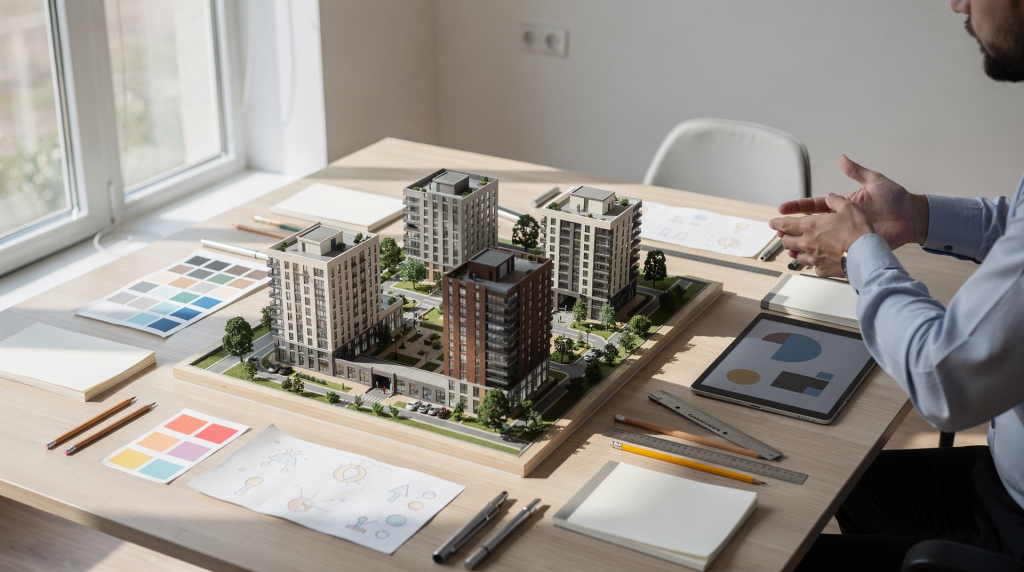
Naming a residential complex is not a creative afterthought; it is a commercial decision that shapes first impressions, supports positioning, and affects how easily buyers remember and talk about the scheme. The best names are distinctive, credible, easy to use in sales materials, and workable across legal, digital, and local authority checks.
Why the name matters
A project name does three jobs at once:
- It signals the type and quality of the development.
- It helps the scheme stand out in a crowded market.
- It becomes the shorthand used in brochures, ads, portals, and sales conversations.
For residential projects, the name often carries more weight than the visual identity at launch. Buyers may see the name before they see the site, the CGI, or the showroom. If the name feels generic, vague, or hard to say, it weakens the entire proposition.
In digital advertising, this sequence is even more pronounced. A paid social ad or a property portal listing shows the name first—often as little more than a headline stacked against four competing developments in the same postcode. If the name fails to evoke curiosity or credibility in that split second, the click never happens, regardless of how compelling the creative is. I have watched campaigns where a weak name dragged down click-through rates by 20–30%, simply because the language felt indistinguishable from every other “Quarter” or “Gardens” in the feed.
The name also shapes how sales teams talk about the project. Agents need something they can say naturally in conversation, something that carries the right emotional weight without sounding scripted. When a name feels awkward or overly manufactured, it creates friction in the very human moment of selling a home. That friction costs momentum, and in a competitive launch window, momentum is everything.
Start with strategy, not wordplay
Before brainstorming names, define the development clearly.
Ask these questions first
- What is the product: build-to-rent, private sale, affordable housing, luxury apartments, or mixed-use?
- Who is the primary buyer or tenant?
- What is the price bracket?
- What is the key differentiator: location, architecture, amenity, heritage, sustainability, or lifestyle?
- What emotional response should the name create?
- Should the scheme feel premium, contemporary, local, family-friendly, or investment-led?
A name should reinforce the positioning. If the scheme is designed for young professionals, the name may need to feel urban and efficient. If it is a landmark waterside project, a more evocative and place-led name may work better.
I have seen too many naming workshops derail because the team jumped straight into word association without first agreeing on what the development actually represents. You end up with a list of forty options that could belong to any scheme in any city. The strategic questions above act as a filter before the filter exists—they define the emotional territory and the commercial boundaries simultaneously.
One nuance worth mentioning: the emotional response question deserves more time than most teams give it. A name that feels “calm” generates a completely different buyer journey from one that feels “dynamic.” This choice affects everything—photography direction, copywriting tone, even the design of the sales gallery. Getting alignment on this early prevents costly creative rework later.
Build the naming brief
Treat naming like a structured project. A strong brief usually includes:
- Development type
- Target audience
- Location and local references
- Architectural character
- Brand personality
- Competitor set
- Tone of voice
- Mandatory words or exclusions
- Launch timeline
- Legal and domain constraints
A good brief prevents subjective discussions later. Instead of “We like this one,” the team can ask whether a name fits the agreed strategy.
The “mandatory words or exclusions” line item is more powerful than it appears. Some developers carry brand architecture rules across their portfolio—certain words are reserved for premium tiers, others are deliberately avoided. If the scheme sits within a wider masterbrand, the naming brief must account for how this project’s name will coexist with siblings in the portfolio. I have worked on portfolios where the naming hierarchy alone clarified the product segmentation for buyers before a single brochure was printed.
Domain constraints deserve early attention too. A perfect name that cannot secure a clean domain or consistent social handles creates friction across every digital touchpoint. Buyers will search for the name; if what they find is fragmented or unrelated, it chips away at credibility.
The main naming routes for residential developments
Most residential complex names fall into a few broad categories.
| Naming route | What it does well | Risks | Best use |
|---|---|---|---|
| Place-led | Connects the scheme to its location and history | Can feel predictable if overused | Regeneration areas, local identity projects |
| Architectural | Reflects form, height, materials, or layout | Can become generic quickly | Landmark buildings, design-led schemes |
| Aspirational | Suggests lifestyle, prestige, or calm | Can sound artificial if overdone | Premium and upper-mid-market developments |
| Heritage-led | Uses local history, former land use, or legacy | Needs accuracy and sensitivity | Sites with strong context or narrative |
| Nature-led | Draws from trees, water, light, landscape | Very common, so distinctiveness matters | Garden communities, waterside or suburban schemes |
| Urban/modern | Feels sharp, contemporary, and efficient | Can become cold or forgettable | City-center apartments, PRS, compact schemes |
The strongest names usually combine relevance with restraint. A name does not need to explain everything. It needs to feel believable and memorable.
What makes the difference between a competent name and a powerful one is often the discipline to choose one dominant route rather than trying to satisfy three at once. A name that tries to be simultaneously heritage-led, nature-led, and aspirational usually collapses into vagueness. The table above is useful precisely because it forces a primary commitment. Once that commitment is made, a secondary cue can add depth—a place-led name with a subtle architectural undertone, for example—but the hierarchy must be clear.
From a brand architecture perspective, the chosen route also signals something about the developer’s intent. A heritage-led name suggests confidence in context and permanence; an aspirational name signals ambition and lifestyle focus. Buyers may not articulate this consciously, but they absorb it. The name sets expectations that every subsequent touchpoint must meet.
What makes a strong residential complex name
A good name should pass a simple practical test.
It should be:
- Easy to pronounce
- Easy to spell
- Distinct from nearby developments
- Appropriate for the price point
- Flexible enough for signage, brochure copy, and digital ads
- Suitable for both launch and long-term use
- Credible for buyers, agents, lenders, and local stakeholders
It should avoid being:
- Overly cute
- Hard to pronounce
- Generic to the point of invisibility
- Too similar to existing local schemes
- Overly descriptive in a way that limits future brand development
- Culturally awkward or unintentionally negative
A name like “The Residences” may feel elegant internally, but it is weak commercially unless supported by a very strong place or brand architecture.
I want to expand on that last point because “The Residences” is a trap I have watched multiple developers walk into. In isolation, it sounds refined. In the market, it is invisible. Without an anchoring place name or a distinctive brand prefix, it communicates nothing about product type, location, or character. It also performs terribly in search—try finding “The Residences” in a city with five other developments using the same suffix. The name survives only when the developer’s corporate brand is strong enough to carry the meaning, functioning as a sub-brand rather than a standalone identity.
The price-point test deserves equal attention. A name that sounds premium for a mid-market scheme creates a credibility gap that sales teams struggle to close. Buyers arrive with inflated expectations and leave disappointed. Conversely, a name that undersells a genuinely premium product leaves margin on the table. The name and the price must feel like they belong together.
Practical naming process step by step
1. Define the positioning
Write one sentence that explains what the development is and why it matters.
Example:
“A mid-rise waterside residential scheme for young professionals, positioned around calm design, strong transport links, and shared amenities.”
This sentence becomes the filter for every naming idea.
2. Choose the naming territory
Decide whether the name should lean toward:
- Local place
- Heritage
- Lifestyle
- Architecture
- Nature
- Mixed strategy
Do not mix too many directions at once. If the brief includes local history, waterside setting, and premium lifestyle, choose one main territory and one supporting cue.
3. Create a longlist
Generate 20–30 options first. At this stage, quantity matters more than polish.
Useful sources for inspiration:
- Historic maps
- Site history
- Local landmarks
- Former land use
- Natural features
- Architectural forms
- Street names
- Community references
- Nearby cultural institutions
4. Shortlist with hard criteria
Reduce the list using practical filters:
- Does it fit the audience?
- Does it sound premium enough?
- Is it too close to competitors?
- Can it work in headlines and URLs?
- Does it sound like a real place?
- Can sales teams say it naturally?
5. Test the shortlist in context
Read each name aloud in real usage:
- “Welcome to…”
- “Apartments at…”
- “Register your interest in…”
- “Launching soon at…”
- “Now selling at…”
Names often sound better in a brainstorm than in sales copy. Context exposes weak options quickly.
The longlist stage is where most teams rush, and it shows in the final result. Spending genuine time with source materials—old maps, local archives, conversations with long-term residents—often surfaces naming ideas that feel authentic rather than manufactured. A name drawn from the site’s actual history carries a weight that no invented word can replicate. It also gives the sales team a genuine story to tell, which matters enormously in buyer conversations.
When shortlisting, I recommend applying the “real place” test ruthlessly. Ask yourself: would this name exist naturally, or does it only exist because a marketing team created it? The most convincing residential names feel like they were discovered, not invented. That sense of inevitability builds trust before a buyer ever visits the site.
Legal and practical checks you should never skip
A great-sounding name can still fail if it cannot be used properly.
Check for these issues early
- Existing trademark conflicts
- Similar development names in the same market
- Domain availability
- Social handle availability
- Local authority street naming and numbering rules
- Royal Mail and address registration requirements
- Whether the name can be used officially or only as a marketing name
In the UK, local authority and postal rules matter. A building may have a marketing name, but the official address structure still needs to be workable. In some cases, councils require a list of proposed names and may prefer names with local historical relevance. In practice, that means naming is not only branding work; it is also address management.
Important distinction
- Marketing name: the brand name used in campaigns, brochures, and sales materials.
- Official address: the registered name or numbered address used for postal and administrative purposes.
These are not always the same. A project can have a strong brand name while still needing a formal address structure that follows local requirements.
This section might feel bureaucratic, but I treat it as a strategic checkpoint, not a formality. I have watched a beautifully crafted name collapse at the final hurdle because a nearby competitor already held a confusingly similar trademark, or because the council rejected the proposed street name. The earlier these checks happen—ideally during shortlisting, not after final sign-off—the less expensive the fix.
The marketing name versus official address distinction has practical implications for how buyers find and refer to the development. If the two diverge too sharply, confusion creeps into delivery addresses, visitor navigation, and online search behavior. The best projects align them as closely as local rules allow, so that the name used in advertising is also the name people encounter when they arrive.
Common mistakes when naming residential schemes
1. Choosing a name too early
Teams often fall in love with a name before the positioning is clear. That creates rework when the brand strategy changes.
2. Overusing obvious words
Words like “Heights,” “Residences,” “Quay,” “Place,” and “House” are common in property naming. They can work, but only if the full name is distinctive enough.
3. Ignoring competitor names
If nearby developments use similar language, your name may disappear in listings and search results.
4. Making the name too literal
A literal name can describe the site but fail to create identity. If every project near water becomes “Waterside,” differentiation vanishes.
5. Forgetting long-term use
A name that works for launch may become awkward in post-completion communications, resident materials, wayfinding, or resale.
6. Failing to check pronunciation
If sales teams, brokers, and buyers will hesitate every time they say the name, it is not a strong candidate.
The “choosing a name too early” mistake is particularly common in developer-led projects where the name emerges organically from internal discussions long before the branding team is engaged. By the time the strategy work begins, the name has already acquired emotional attachment and internal momentum. Unwinding that is difficult. The antidote is to sequence the work correctly: positioning first, naming brief second, creative exploration third.
On the pronunciation point, I would add a specific lens rarely discussed: international buyer audiences. If the scheme targets overseas investors or relocating professionals, the name must be pronounceable across languages without producing awkward or unintended meanings. A name that sounds sophisticated in English might be unpronounceable or comical in Mandarin or Arabic. This is not a niche concern in major EMEA gateway cities where international buyers represent a significant share of absorption.
A simple scorecard for evaluating name options
Use a 1–5 score across each criterion.
| Criterion | Score 1 | Score 3 | Score 5 |
|---|---|---|---|
| Distinctiveness | Generic | Somewhat memorable | Clearly stands out |
| Relevance | Weak fit | Partial fit | Strong strategic fit |
| Ease of use | Awkward | Usable with effort | Natural in all contexts |
| Premium feel | Flat | Acceptable | Confident and credible |
| Legal viability | High risk | Needs review | Clean and workable |
| Digital practicality | Hard to search | Mixed | Easy to support online |
A name does not need a perfect score everywhere, but it should not fail on distinctiveness, legal viability, or usability.
I find the scorecard most valuable as an alignment tool rather than a rigid scoring mechanism. When a developer and agency disagree on a name, the scorecard shifts the conversation from subjective preference to structured evaluation. It also reveals patterns: if a shortlisted name scores well on distinctiveness but poorly on relevance, the team can discuss whether distinctiveness alone is sufficient for the specific market context. In a regeneration area with strong community identity, relevance may matter more than in a transient city-center PRS scheme.
Example naming logic
For a city-center apartment scheme
A name should usually feel efficient, modern, and easy to search. Overly romantic wording may feel out of place.
For a waterside regeneration project
A name can lean into movement, light, or local geography, but it should avoid sounding generic or promotional.
For a heritage-led conversion
The name should respect the original building or site history without sounding forced. If the heritage link is thin, do not manufacture one.
For a family-focused suburban scheme
The name should feel welcoming, stable, and easy to remember. Clarity matters more than drama.
These examples highlight how the same naming principles produce different outcomes depending on product and audience. A city-center build-to-rent scheme targeting young professionals needs the name to perform in search-heavy digital journeys—buyers will Google it alongside terms like “apartments city center” and “rental near station.” SEO considerations become part of the naming logic, not an afterthought. By contrast, a heritage conversion in a known landmark often benefits from a name that prioritizes story over searchability, because discovery happens through different channels—press coverage, local reputation, word of mouth among buyers who already know the building.
The family-focused suburban case deserves one additional layer: names in this category often work hardest in the resale market years after launch, when the development competes against newer schemes. A name that ages gracefully—feeling established rather than dated—supports long-term value retention.
Checklist before final approval
- The name matches the brand strategy.
- The name is easy to pronounce and spell.
- The name is distinct from nearby developments.
- The trademark position has been reviewed.
- Domain and digital assets are available or can be secured.
- The name works in brochure copy, ad headlines, and signage.
- The official address process has been checked.
- Internal stakeholders agree on pronunciation and usage.
- The sales team can explain the name in one sentence.
That last item—the sales team being able to explain the name in one sentence—is a test I apply to every shortlisted option before final presentation. If the narrative behind the name requires a paragraph of context, it will fail in the compressed environments where most buyer encounters happen: a property portal headline, an Instagram story, a broker’s elevator pitch. The best names carry their own explanation. They invite the question “What’s the story behind the name?” rather than requiring a preemptive justification.
How to present the name internally
Do not submit names without context. Stakeholders make better decisions when each option is framed properly.
For each shortlisted name, include:
- The naming route
- The strategic rationale
- The tone it creates
- Any risks or limitations
- The intended use case
- Notes on legal or address checks
This turns naming from personal preference into a business decision.
I structure these presentations so that the commercial logic leads and the creative appeal follows. Stakeholders who are not brand specialists need to see how the name supports sales velocity, not just creative coherence. When I present naming options, I connect each one directly to the buyer journey: what does this name make a prospective buyer feel when they encounter it on Rightmove versus on a site hoarding versus in a sales brochure? Grounding the discussion in real buyer touchpoints moves it away from personal taste and toward strategic fit.
Final advice
The best residential complex names are not the most poetic ones. They are the ones that fit the scheme, support sales, survive legal checks, and remain credible over time. If a name is distinctive, easy to use, and rooted in the project’s actual positioning, it will do far more work than a clever but fragile concept.
After years of naming residential projects across different markets, I have learned that the names that endure are rarely the ones that generated the most excitement in the workshop. They are the quiet, solid choices that kept passing every practical test while the clever options stumbled on a legal check or an awkward pronunciation. The discipline of naming is not about finding the most creative idea; it is about finding the most resilient one—the name that works as hard in year five as it does on launch day, across every channel, for every audience, without needing to be explained.
FAQ
How early should a residential complex be named?
As early as possible in the branding process, but only after the positioning, audience, and naming constraints are clear.
Should the name always reflect the location?
Not always, but it usually helps. Location-led naming works well when the site has a strong identity or local recognition.
Can a residential complex have both a marketing name and an official address?
Yes. In many cases, the marketing name and the registered address are different, and both need to be considered.
What is the biggest naming mistake developers make?
Choosing a name that sounds attractive in isolation but fails on distinctiveness, legal checks, or day-to-day usability.
Is a descriptive name better than an invented one?
It depends on the project. Descriptive names are clearer, while invented names can be more distinctive. The best choice is the one that fits the brand strategy and the market context.