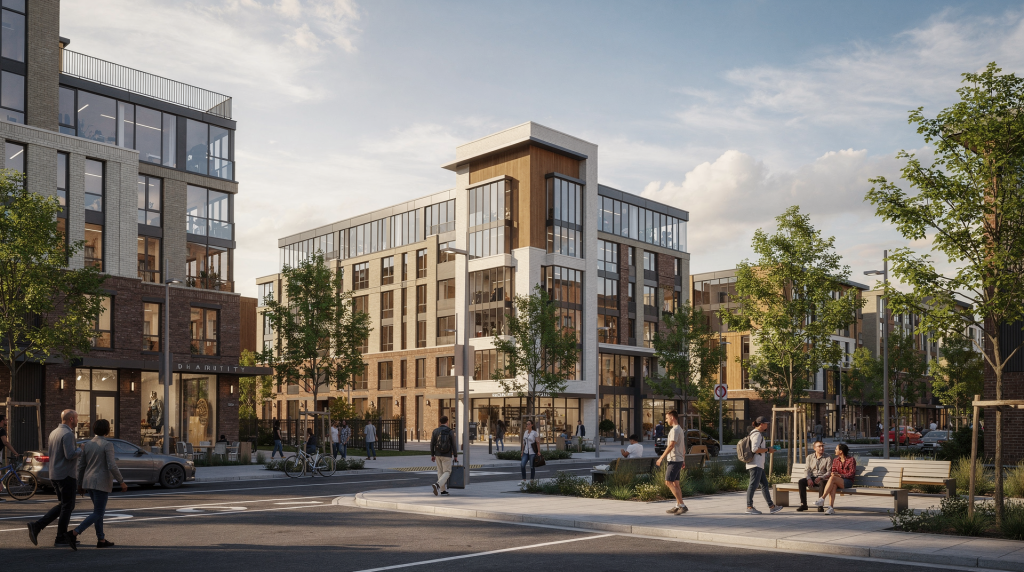
A strong identity for a new urban district is not a logo, a name, or a launch campaign. It is the operating system that makes the place feel coherent, credible, and memorable across planning, marketing, public realm, and long-term management. When done well, it helps a district attract residents, businesses, visitors, and investors while remaining authentic to local character.
In residential and mixed-use development, I’ve seen this play out repeatedly: the projects that command premium pricing and faster absorption aren’t necessarily the ones with the best architecture. They’re the ones where every touchpoint—from the first digital ad a buyer sees to the way the sales gallery smells—reinforces a single, believable idea. That’s what a district identity does. It turns a collection of buildings into a place people want to belong to.
Why district identity matters
New districts often start as empty land, phased construction sites, or a fragmented mix of old and new fabric. The market has very little to “read” except the promise in the masterplan, so identity does a lot of heavy lifting. Buyers aren’t just purchasing square meters; they’re buying into a future lifestyle they can’t yet touch or walk through. The brand has to bridge that gap.
A clear identity helps a district:
- stand out from competing schemes in the same city or metro area
- turn planning intent into a recognisable public story
- align developers, planners, sales teams, and local stakeholders around one direction
- support place perception over time, not only at launch
- connect physical design with communication, wayfinding, activations, and digital content
The biggest mistake I encounter is treating identity as a late-stage branding exercise. When the story only appears after naming and visual design are finished, the district usually feels generic or disconnected from the actual place. I’ve walked into sales galleries where the brochure promises “vibrant urban living,” but the hoardings outside are blank, the route from the metro is confusing, and the sales team can’t articulate what makes this project different from the one two blocks away. That disconnect costs developers millions in slower sales velocity and weaker pricing power.
What “identity” means in practice
For a new urban district, identity is the combination of several interdependent layers. It’s not a tagline or a color palette—it’s the full system that shapes how people perceive and experience the place.
- Positioning: what the district is for and why it matters compared with alternatives. In residential marketing, this answers the buyer’s unspoken question: “Why should I live here instead of there?”
- Character: the human qualities people should associate with the place—warm, efficient, cosmopolitan, grounded. These aren’t adjectives on a mood board; they guide everything from the choice of street trees to the tone of the Instagram ads.
- Experience: how the district feels on the ground through streets, services, public spaces, and events. This is where branding meets operations. If the identity says “family-friendly,” but there’s no stroller access to the park, the brand breaks.
- Narrative: the story that ties history, ambition, and future use into one coherent idea. A good narrative doesn’t just describe; it gives buyers a role to play. They become part of the story, not just consumers of it.
- Visual and verbal expression: naming, tone of voice, graphic system, signage, and sales materials. These are the tangible outputs, but they only work if they’re rooted in the layers above.
A district identity should feel broader than a campaign, but more practical than a theoretical vision. If it cannot guide wayfinding, marketing, placemaking, and content creation simultaneously, it is too vague to be useful. I often tell developers: your brand guidelines should be as useful to the wayfinding consultant as they are to the digital media buyer. If they’re not, you’ve built a decoration, not an identity.
Start with the right research
A credible identity begins with a hard look at what already exists. Strong place-branding work is built on research, stakeholder input, and a realistic inventory of assets rather than assumptions. In my experience, the projects that skip this step end up with identities that sound impressive in the boardroom but fall flat in the market.
What to study first
- location and connectivity
- surrounding neighbourhoods and their reputations
- historical layers, land use, and local memory
- target audiences and likely occupier mix
- physical assets: waterfronts, parks, transit, views, civic anchors
- weaknesses: isolation, contamination, fragmented ownership, weak edges
- market context: competing districts, rent levels, buyer profiles, vacancy trends
Questions to answer early
- What is genuinely distinctive here?
- Which parts of the story are already true today?
- What can be improved through design and programming?
- What must not be overclaimed?
- Who needs to recognise themselves in the identity for it to work?
This step is essential because a district identity that ignores local reality loses trust quickly. In place branding, authenticity is not a soft nice-to-have; it is what makes the brand believable to residents and stakeholders. I’ve seen projects where the research revealed that the site’s real strength wasn’t the “heritage” the developer wanted to push, but the extraordinary transit connectivity that could appeal to dual-career families. That insight reshaped the entire positioning—and the media plan.
Build the identity around a clear proposition
The most useful way to define a new district is to write a single proposition statement. It should explain what the district offers, for whom, and why it is relevant. This isn’t copywriting for the website; it’s an internal decision-making tool that keeps everyone aligned.
Simple formula
This district is a place for [audience] who want [benefit] in a setting defined by [distinctive attributes].
Example:
A mixed-use riverside district for people who want walkable urban living, everyday convenience, and a strong connection to the water.
That sentence is not copywriting. It is a filter. It helps teams judge whether design choices, naming, tenant mix, and content all belong to the same idea. When a developer tells me they’re considering a retail tenant that doesn’t fit, or a digital ad creative that feels off, I point back to the proposition. If it doesn’t serve that sentence, it dilutes the brand.
Core components of a strong district identity
1. A believable story
The story should connect where the district came from, why it is being built now, what problem it solves, and what kind of life it enables. In residential marketing, the narrative is what turns a unit into a home in the buyer’s mind before they’ve even seen the floor plan.
If the site has an industrial past, that can inform language, materials, and visual cues—but only if it’s genuine. If the area sits between established neighbourhoods, the story may be about connection and permeability. If it introduces a new civic destination, the story may focus on openness, culture, and public life.
Avoid forced narratives. A district does not need a dramatic heritage story if the real strength is spatial quality, transport access, or a new mixed-use lifestyle. I’ve worked on projects where the developer wanted to invent a “creative quarter” story, but the research showed buyers were actually drawn to the practicality of the location. We built the narrative around “effortless urban living” instead—and the sales team told us it resonated immediately because it matched what buyers were already thinking.
2. A distinctive name
Naming should support positioning, not decorate it. A good name is easy to say, easy to remember, and compatible with the district’s long-term ambitions. It also needs to work in digital environments—short enough for a domain name, distinctive enough for search, and memorable in a social media feed.
Name checks
- Does it sound natural in local usage?
- Can it work across phases?
- Does it hold up in planning documents, signage, and digital campaigns?
- Does it avoid confusion with nearby places?
- Can it support sub-brands for neighbourhoods, blocks, or destinations?
Weak names often sound either too generic or too promotional. Strong names feel place-based, not invented for their own sake. I’ve seen names that tested well in focus groups but failed in real life because they were too clever or too abstract. The best names often come from something real: a historical reference, a geographical feature, a street name. They ground the project in truth.
3. A visual system rooted in place
Identity systems for urban districts work best when they reflect spatial logic, materials, movement, or landscape cues rather than purely decorative branding. The visual identity should feel like it grew out of the site, not like it was applied to it.
Useful sources of visual inspiration include:
- street grids and block rhythms
- topography or waterfront geometry
- local materials and textures
- historic layers translated in a contemporary way
- circulation patterns and landmarks
A practical rule
If the visual identity could belong to any development anywhere, it is not specific enough. I test this by showing the logo and key visual elements to someone unfamiliar with the project and asking, “What does this tell you about the place?” If the answer is “nothing,” we go back to the drawing board.
4. A tone of voice with discipline
The verbal identity should match the district’s actual market position. A family-oriented neighbourhood, a creative mixed-use quarter, and a premium waterfront district do not sound the same. Yet many developers use the same generic language across all their projects, which erodes differentiation.
Tone of voice should define:
- vocabulary to use
- vocabulary to avoid
- sentence length and pace
- level of sophistication
- how technical terms are explained
- how claims are framed without sounding inflated
Keep language concrete. Replace abstract phrases like “vibrant destination” with evidence-based wording such as “a walkable district with homes, cafés, workspaces, and a central park.” In digital advertising, where you have seconds to capture attention, concrete language outperforms vague promises every time. Buyers scrolling through property listings are looking for specifics they can picture themselves in.
Translating identity into the real place
A place brand is not only communicated; it is experienced through touchpoints. Research on place branding consistently stresses the importance of physical and social experience, not just messaging. This is where many residential projects stumble: the brand promise is strong, but the on-site experience doesn’t deliver.
Key touchpoints to align
- sales and leasing materials
- website and digital advertising
- signage and wayfinding
- hoardings and construction communications
- public realm and street furniture
- events and temporary activations
- partner and tenant communications
- launch presentations and community briefings
Why this matters
If the brand promises “connected urban living” but the first thing people see is confusing access, blank fencing, and inconsistent signs, the identity collapses in practice. The physical environment must reinforce the promise. I’ve seen projects where the digital ads were beautiful, the website was compelling, but the sales gallery was in a temporary cabin with no sense of arrival. Buyers felt the disconnect immediately, and conversion rates suffered. Every touchpoint is a test of the brand’s credibility.
A step-by-step process for creating district identity
Step 1: Diagnose the site
Map the assets, constraints, audience segments, competitive set, and planning context. This is the foundation. Without it, you’re building on assumptions.
Step 2: Define the strategic role of the district
Decide whether the place is meant to be:
- a residential neighbourhood
- a mixed-use extension of the city centre
- a cultural or creative quarter
- a transit-oriented district
- a waterfront or lifestyle destination
Step 3: Write the identity brief
Summarise proposition, audience, key differentiators, and mandatory truth points. This brief becomes the reference document for every creative and strategic decision that follows.
Step 4: Build narrative territories
Develop 2–4 possible story directions and test them against feasibility and authenticity. Don’t fall in love with one too early. Let the research guide you.
Step 5: Choose the name and verbal system
Stress-test naming options for clarity, longevity, and audience fit. Check domain availability, trademark conflicts, and cultural connotations in all relevant languages.
Step 6: Design the visual identity
Create a system that works in print, digital, signage, and sales environments. It must be flexible enough to adapt across media without losing coherence.
Step 7: Map the touchpoints
Apply the identity to every public-facing moment, not just the launch campaign. This includes construction hoardings, sales team scripts, and the email onboarding sequence for new residents.
Step 8: Govern the brand
Set rules for approvals, partner use, future phases, and updates as the district evolves. A brand without governance is a brand that will fragment within months.
Table: what good district identity should do
| Element | What it should achieve | Common failure |
|---|---|---|
| Positioning | Clarify why the district exists | Too broad, too generic |
| Naming | Make the place memorable and usable | Sounds like a slogan |
| Visual identity | Feel rooted in the site | Looks interchangeable |
| Tone of voice | Match the audience and offer | Overpromises or feels corporate |
| Public realm cues | Reinforce the story in space | Branding exists only online |
| Governance | Keep the identity consistent over time | Fragmented use across partners |
Common mistakes to avoid
- starting with design before defining strategy
- copying the language of other developments
- overusing words like “vibrant,” “iconic,” and “unique”
- building an identity around future aspirations that are not yet visible
- ignoring how residents and local stakeholders will receive the brand
- making the district feel closed or overly commercial
- failing to create sub-brand rules for phases and zones
- treating launch materials as the only brand output
The most damaging mistake is mismatch: the promise, the built environment, and the experience should point in the same direction. In residential marketing, this mismatch is often most visible in digital advertising. A campaign might promise “serene waterfront living,” but the landing page shows renderings that look onto a construction site, or the sales team isn’t briefed on the water access timeline. Buyers notice. And they walk away.
How to test whether the identity is working
A useful district identity should pass a few practical tests. I use these with every project before we go to market.
Clarity test
Can someone explain the district in one sentence after seeing the name and materials? If they hesitate or reach for jargon, the identity isn’t clear enough.
Relevance test
Does the identity speak to the intended audience without excluding the broader market? A family-focused district shouldn’t alienate young professionals who might also be interested, but it should clearly signal its primary audience.
Authenticity test
Does it reflect something true about the site, or does it sound invented? Buyers have a keen radar for inauthenticity. If the story feels manufactured, they’ll dismiss it.
Flexibility test
Will it still work when new phases, uses, or tenants arrive? A good identity has enough structure to remain recognisable and enough flexibility to evolve.
Delivery test
Can the identity be expressed through architecture, signage, digital content, and on-site experience? If it only lives in the brand guidelines PDF, it’s not an identity—it’s a document.
If the answer is no to any of these, the identity is not ready for market.
Checklist: what to prepare before launch
- master positioning statement
- audience profile by user group
- naming rationale
- visual identity guidelines
- tone of voice guide
- signage and wayfinding principles
- launch narrative and key messages
- website content structure
- social and paid media toolkit
- stakeholder communication pack
- brand governance process
FAQ
What is the difference between place branding and urban district identity?
Place branding is the broader discipline of shaping perception of a place—it can apply to cities, regions, or nations. Urban district identity is the specific strategic and design system used to define one district within that place. Think of it as the difference between a corporate brand and a product brand. The district identity must align with the wider place brand but have its own distinct character.
Should a new district identity be led by marketing or planning?
It should be developed jointly. Planning defines what the place can be; marketing defines how it should be understood; operations and design make it real. When these disciplines work in silos, the identity suffers. I’ve seen planning teams create brilliant masterplans that marketing couldn’t sell because no one had translated the spatial vision into a human story. And I’ve seen marketing teams create beautiful campaigns that promised things the planning approvals would never allow. Collaboration from day one is the only way.
How early should identity work start?
As early as possible, ideally when the spatial concept, audience strategy, and naming territory are still open. Waiting until launch usually weakens the result because too many decisions have already been locked in. The identity should inform the masterplan, not just decorate it.
Can one identity work across multiple phases?
Yes, but only if the system is designed for it. The core proposition should remain stable while neighbourhoods, buildings, and activations can have their own sub-identities. This requires a brand architecture that defines the relationship between the master brand and the phase brands. Without that architecture, you get fragmentation.
What makes a district identity feel authentic?
It reflects real site conditions, local history, intended use, and lived experience. Authenticity comes from alignment between story and reality, not from nostalgia alone. Buyers can sense when a brand is trying too hard to be something it’s not. The most authentic identities often emerge from embracing constraints rather than hiding them.
Conclusion
Creating an identity for a new urban district means turning land, plans, and ambitions into a place people can understand and trust. The strongest identities are built from real research, a clear proposition, and consistent expression across naming, design, communication, and the built environment.
When the strategy is sharp and the delivery is disciplined, the district becomes more than a development. It becomes a place with memory, direction, and commercial momentum. In a competitive residential market, that’s not just a branding success—it’s a sales advantage that compounds over time.